Short answer
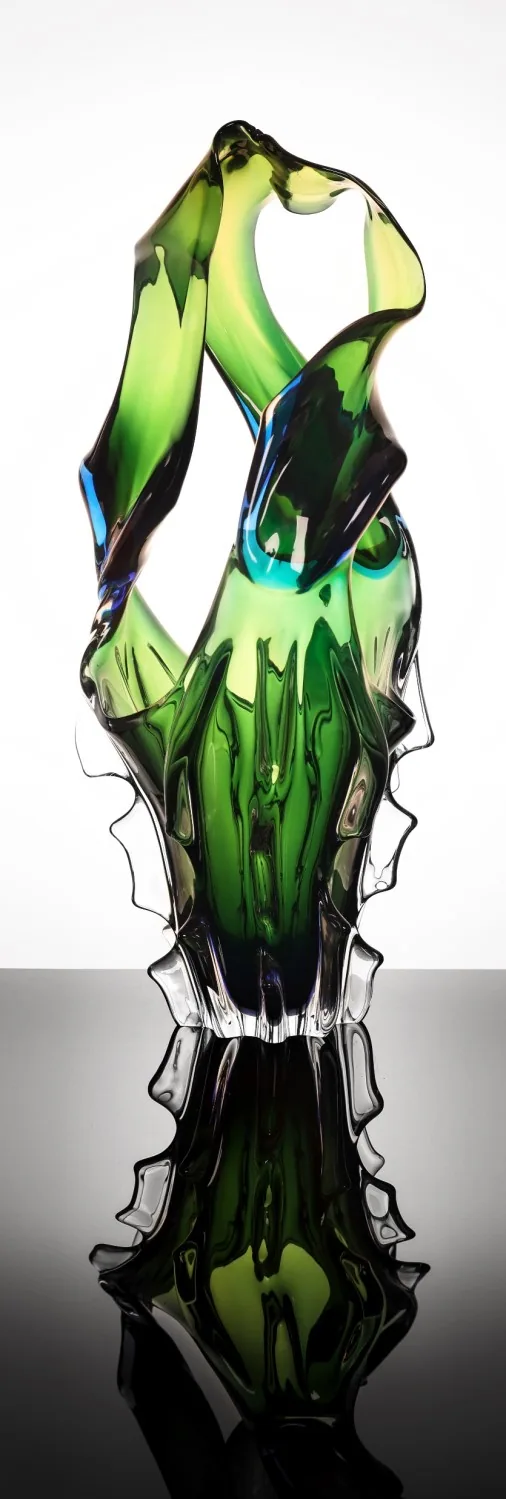
Cased crystal glass is a vessel built from several fused layers of glass in different colours. A clear or lightly tinted lead crystal body is covered with one or more thin coloured glass layers, then a craftsman cuts, grinds and polishes through the outer layers to expose what lies beneath. The colour is part of the glass wall, not a coating, so the pattern has real depth and changes with the light.
Key facts at a glance
- Also called
- Cased glass, multi-layer cased crystal, overlay glass, cut-back glass
- Layer thickness
- About 0.8–1.5 mm of coloured glass on a vessel roughly 600 mm high and 300 mm in diameter
- Core material
- High-lead crystal glass; the workshop uses 24PbO high-lead crystal for its signature pieces
- Finishing sequence
- Cutting, grinding, reheating, engraving, sandblasting and polishing, all by hand
- Produced in-house
- Multi-colour casing and hand engraving are performed in the same Dalian workshop
How the layers are built
The process starts with a blown crystal body. While the glass is still workable, a thin layer of coloured glass is gathered and applied over the surface, then fused so the two become one wall rather than two stuck together. Repeating the gather with different colours builds a stack of layers. Each layer has to cool and reheat without cracking, which is the difficult part: the layers must share compatible expansion behaviour.
Once the blank has cooled, the engraver works from the outside in. A wheel-cut facet, a floral motif or a band is ground through the coloured casing until the layer below appears. Where the cut stops, a different colour shows. That is why a cased piece can carry three or four colours in one continuous surface with no paint and no seams.
Why the thin casing is the hard part
On a vessel around 600 mm high and 300 mm in diameter, the coloured casing is only about 0.8 to 1.5 mm thick. Cutting through a skin that thin across a curved, hand-blown form is unforgiving: go a fraction too deep and the colour below is lost; stop too early and the pattern disappears under the surface colour. The workshop that controls both the casing and the engraving can tune the layer thickness to the design. Buying the blank from one supplier and sending it out for engraving usually cannot.
Cased crystal vs single-layer coloured glass
A comparison that is useful when writing a specification:
| Feature | Multi-layer cased crystal | Single-layer coloured glass | Coated or printed glass |
|---|---|---|---|
| Where the colour sits | Fused into the wall as distinct layers | Throughout the whole wall | On the surface |
| Pattern | Cut back through layers, physical depth | Surface cut or moulded | Flat, no depth |
| Colour count | Several colours in one continuous surface | One colour per piece | Multiple, but surface only |
| Typical use | Collector vases, awards, presentation pieces | Tableware, everyday vases | Promotional items |
| Wear | Pattern is in the glass | Pattern is in the glass | Can wear or fade |
How to specify cased crystal in an inquiry
State the silhouette and the dimensions you need, then the colour family for the outer casing and the colour you want revealed beneath it. Say which areas should be cut back and which should stay solid. If the piece carries a logo, send vector artwork and say whether you want wheel engraving, sandblasting or laser marking. Add the quantity, target date and destination country.
Ask for a sample or a proof before the production run when the design is new. Because every layer is applied and cut by hand, a signed sample is the most reliable reference for colour depth and cut depth on the finished pieces.
Common questions
Is cased crystal the same as cameo glass? The techniques are close relatives: both cut back a layered blank to reveal a lower colour. Cased crystal usually refers to blown lead crystal vessels with coloured casings, worked at the wheel.
Can the casing colour be matched to a brand colour? Yes, within the limits of glass colour chemistry. Send a Pantone target or a physical reference and the workshop will propose the nearest achievable casing colour, confirmed by a sample.
Will two pieces look identical? No. The layers are gathered and cut by hand, so colour flow and cut depth vary slightly. That variation is a characteristic of the process, not a defect; a signed sample defines the acceptable range.
Ready to specify a piece?
Send the form, quantity, target date and any reference image. Tongbao Art Glass replies within one business day with options and a written quotation.