Short answer
To commission a custom crystal award, send eight things: the purpose of the award, the quantity, the target date, the approximate size, the preferred colour family, the logo or artwork, the engraving effect you want, and the destination country. A short brief plus a reference photograph is enough for a workshop to propose a form and an engraving layout; a sample or proof is then approved before production.
Key facts at a glance
- First response
- Within one business day, from one named contact
- Engraving options
- Wheel engraving, sandblasting, laser marking
- Approval step
- Sample or proof before the production run
- Scale
- A single presentation piece or a series for an entire event
- Packing
- Export-grade foam, reinforced cartons, insurance options
The eight-line brief
A complete first inquiry is shorter than most buyers expect. Put these on one page:
- Purpose — tournament, service anniversary, launch, museum commission or corporate gift.
- Quantity — one hero piece, a small set, or a run for every recipient.
- Target date — the event date, not just the shipping date.
- Size — a height range, or a reference to a catalogue piece.
- Colour family — clear, cobalt, amber, teal, red or a Pantone target.
- Artwork — vector logo, names, dates, or a story the design should express.
- Engraving effect — deep cut, frosted, or fine line detail.
- Destination — country and city, so packing and documentation are scoped correctly.
Engraving methods compared
| Method | How it works | Look | Best for |
|---|---|---|---|
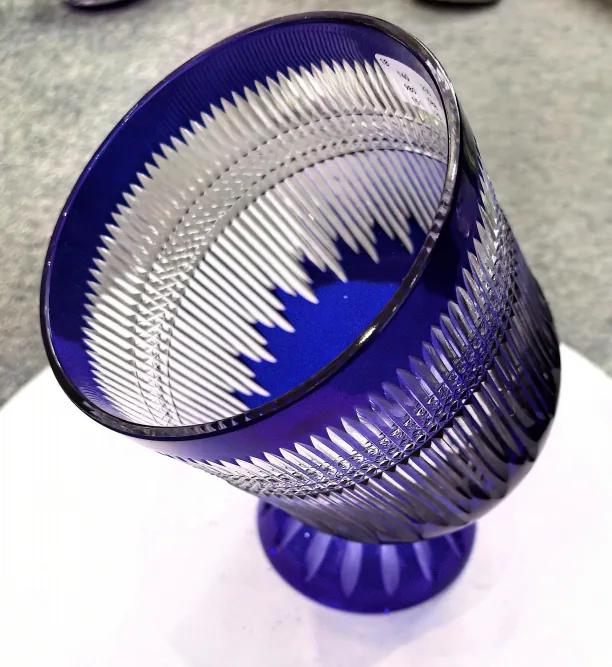
| Wheel engraving | A craftsman cuts the glass at a rotating wheel | Deep facets, catches light, visibly handmade | Hero awards, cased crystal, collector pieces |
| Sandblasting | Abrasive is masked and blasted across the surface | Even frosted contrast, crisp edges | Logos, lettering, repeatable series |
| Laser marking | A focused beam marks the surface | Fine detail, consistent across a run | Names, dates, serial numbering |
What happens after the brief
The workshop replies with a form proposal, feasibility notes and a written quotation. Where the design is new, a sample or a proof is made for approval before production. Blowing, casing, engraving and finishing then happen in the Dalian workshop with checks at each stage. Finally the pieces are packed in export-grade foam and reinforced cartons with documentation for the destination.
The two steps that protect a deadline are the sampling stage and the shipping window. If an event date is fixed, say so in the first message so the schedule is built backwards from it. A change to the artwork after the proof is approved will usually move that date.
Writing a specification that survives translation
Use millimetres rather than vague size words, and attach a dimensioned drawing if the silhouette matters. Name the colour by a physical reference rather than a screen value: glass colour shifts with thickness and with the light behind it. If the piece must stand on a plinth or hold water, say so — base flatness and wall thickness are design inputs, not afterthoughts.
For a recurring programme, ask for a control sample to be kept as the reference for future runs. It makes reorders far easier to match than a photograph and a written description.
Common questions
Do you publish price lists for awards? No. The specification, quantity, engraving and packing all change the quotation, so a written quotation is issued per project.
Can one design cover a whole event series? Yes. A repeatable form can be combined with individual names or dates, so the set reads as one family while each piece is personal.
Can I see the engraving before production? Yes. A proof or sample is shown and approved before the run for custom shapes, colours or engraving layouts.
Ready to specify a piece?
Send the form, quantity, target date and any reference image. Tongbao Art Glass replies within one business day with options and a written quotation.