Short answer
Lead crystal contains lead oxide, which raises its refractive index and density: it is heavier, brighter and gives a clear ringing tone, and it stays workable long enough for deep wheel cutting. Soda-lime glass is lighter, less expensive and common in tableware; borosilicate is chosen for thermal shock resistance. For decorative art glass and awards, lead crystal is usually specified for brilliance and cut depth. Food-contact use is a separate specification and requires its own compliance testing.
Key facts at a glance
- Workshop material
- 24PbO high-lead crystal glass for signature art pieces
- Why lead oxide
- Higher density and refractive index: more weight, more brilliance, a clear ring
- Working property
- Stays workable long enough for deep cutting and multi-layer casing
- Decorative use
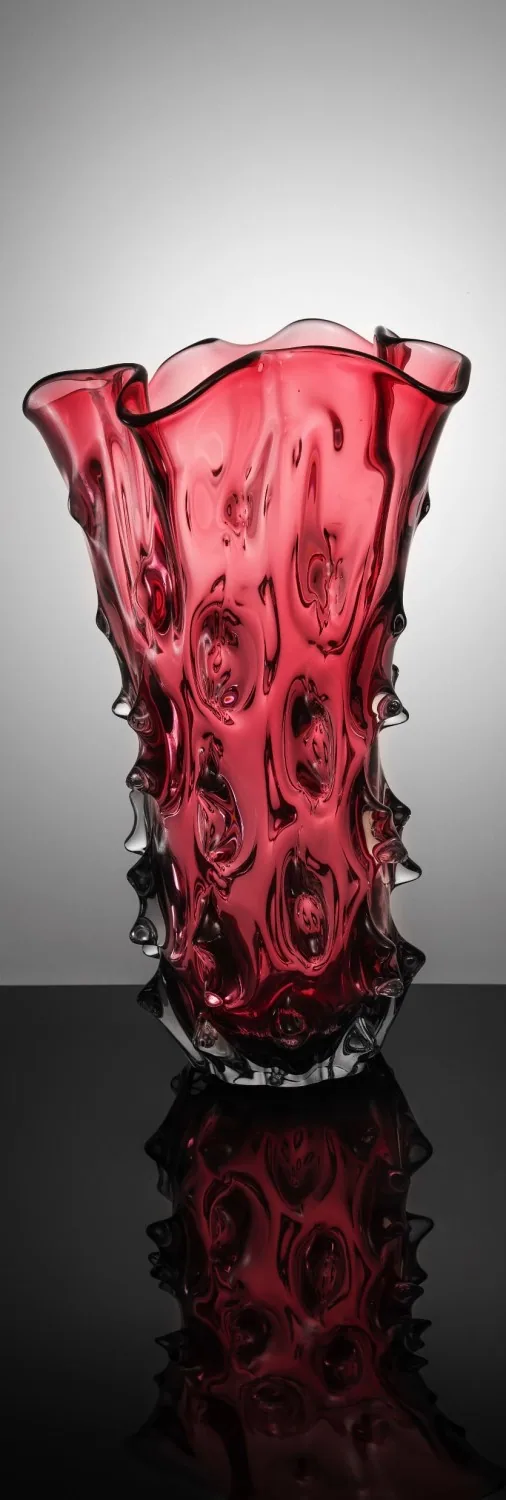
- Vases, bowls, ornaments, trophies and presentation objects
- Food contact
- Not assumed; requires a separate specification and FDA / LFGB testing
What the lead actually changes
Lead oxide replaces part of the silica flux in the batch. The resulting glass is denser and bends light more strongly, which is why a cut facet on lead crystal reads brighter than the same cut on soda-lime. It also softens over a wider working range, giving the craftsman more time at the wheel and at the furnace — a practical requirement when a design needs several coloured casings and deep cut-back engraving.
The differences a buyer can actually check are simple: pick the piece up, look at how a cut edge catches the light, and tap the rim. Lead crystal has noticeable heft, bright facet edges and a clear, sustained tone. Those are the three cues used informally in a showroom.
Comparison at a glance
| Property | Lead crystal | Soda-lime glass | Borosilicate glass |
|---|---|---|---|
| Weight in hand | Heavy for its size | Light to moderate | Light |
| Brilliance | High; strong light return at cut edges | Moderate | Moderate |
| Deep wheel cutting | Well suited | Limited | Not typical |
| Thermal shock | Not the design goal | Moderate | High resistance |
| Typical use here | Cased art glass, awards, vessels | Everyday tableware | Laboratory and heat-resistant ware |
| Compliance focus | Decorative use; food contact tested separately | Food-contact grades available | Food-contact grades available |
The compliance question to ask early
The pieces in our catalogue are decorative art glass: vases, bowls, ornaments and presentation objects. They are not automatically cleared for drinking or food storage. If a project calls for tumblers, decanters or any food-contact item, raise it in the first inquiry. The material, the surface treatment and the decoration all have to be specified against the destination market's rules, with testing such as FDA or LFGB, and that scope is written into the proposal rather than assumed.
This matters more for cased and engraved work than for plain glass: a cut-back pattern changes the surface, and any applied decoration sits on the outside of the wall. A buyer who says 'it must be food safe' at the end of sampling will usually have to restart the specification.
Care and handling
Hand-wash decorative crystal with a soft cloth and mild detergent; avoid abrasive pads and thermal shock. Do not put cased or hand-engraved pieces in a dishwasher. For export, each piece is packed in foam within a reinforced carton, and insurance options are available for fragile cargo.
Common questions
Does lead crystal contain lead on the surface? Lead is bound in the glass matrix. Decorative use is the normal application; food-contact use is a separate specification with its own testing.
Can you make the same design in a lighter glass? Often yes, but the cut depth, weight and light return will change. Ask for a sample in the proposed material before committing to a run.
Is colour part of the glass or painted on? In cased crystal the colour is a fused glass layer. In hot-formed pieces the colour is in the glass itself. Neither relies on a surface coating.
Ready to specify a piece?
Send the form, quantity, target date and any reference image. Tongbao Art Glass replies within one business day with options and a written quotation.