Short answer
Hand-blown art glass is made by gathering molten glass on a blowpipe, shaping it by blowing and by hand at the furnace, cooling it under control, then cutting, grinding, engraving, sandblasting and polishing the cold piece. Because every stage is done by hand, small differences in shape, colour flow and cut depth between pieces are normal. A signed sample, not a photograph, is the right reference for acceptance.
Key facts at a glance
- Core sequence
- Melting, blowing and shaping, controlled cooling, grinding and finishing
- Hot-forming
- Signature sculptural work uses repeated reheating at roughly 1000 °C with hand stretching and hot-formed attachment
- Finishing trades
- Cutting, grinding, reheating, engraving, sandblasting, polishing
- Expected variation
- Slight differences in form, colour flow and cut depth between pieces
- Best practice
- Approve a sample or proof before the production run
The furnace sequence
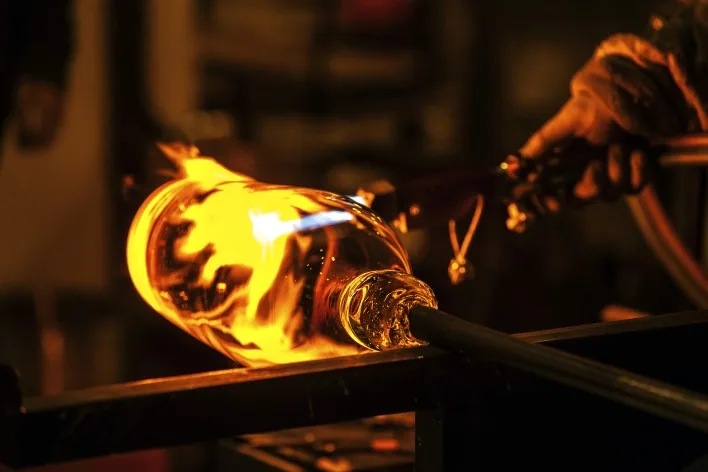
A gather of molten glass is taken from the furnace on a blowpipe. The maker inflates it, then shapes it with gravity, tools and hand movements while the glass is still workable. For free-form sculpture the piece may be returned to the heat several times: the workshop's signature sculptural work uses repeated reheating at roughly 1000 °C, hand stretching and hot-formed attachment to build an open, hollow form. The piece is then cooled under control so the thick and thin sections do not fight each other.
Only after the glass is cold does the surface work begin. Cutting, grinding, reheating, engraving, sandblasting and polishing are separate trades, and a single object can pass through all of them. In cased crystal, this is the stage where the engraver cuts back through the coloured layers to reveal the colours below.
Why handmade glass is not identical
The movement of the glass at the furnace is part of the design. Two vases blown to the same brief will differ slightly in profile, in how the colour flows through the wall and in the depth of a hand-cut facet. That variation is a characteristic of the process. It is not a defect, and trying to remove it entirely would mean a different product.
The practical answer is to define an acceptable range, not a perfect match. Approve a sample before the run, agree what may vary, and use that sample as the reference when the shipment is checked. For repeat programmes, keep a control sample at the workshop for future orders.
Eight-point inspection checklist
- Silhouette — stands true, no unintended lean; base flat enough for the intended surface.
- Dimensions — height, diameter and opening within the agreed range in millimetres.
- Wall — no thin spots that read as fragile when the piece is held to the light.
- Casing — colour layer continuous, no missed gathers or unintended overlap.
- Cut depth — motifs reveal the intended underlying colour and match the approved sample.
- Surface — polish is even; no stray scratches, sharp edges or residual abrasive.
- Bubbles and inclusions — within the agreed range for handmade glass; no cluster that weakens the wall.
- Packing — foam fit, reinforced carton, piece immobile when the box is gently shaken, documents enclosed.
Common questions
Are bubbles a fault? A few small bubbles are normal in hand-blown glass. What matters is whether they cluster, sit in a load-bearing area, or fall outside the range agreed on the sample.
Can a shape be reproduced for a retail collection? Yes. A repeatable design is developed with a mould or a controlled blowing process; sampling confirms how consistent the run will be.
How is fragile glass shipped? Export-grade foam and reinforced cartons, with insurance options for fragile cargo. Packing details are confirmed in the written quotation.
Ready to specify a piece?
Send the form, quantity, target date and any reference image. Tongbao Art Glass replies within one business day with options and a written quotation.